

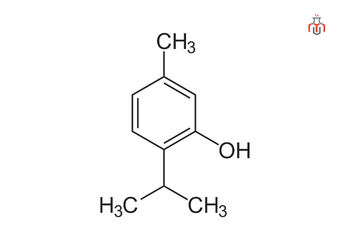
Thymol is a naturally occurring monoterpenoid phenol found in essential oils of aromatic plants such as thyme and oregano. It has the molecular formula C₁₀H₁₄O and generally appears as colorless crystals or a white crystalline powder with a distinctive thyme-like aroma. Its chemical structure contains a phenolic hydroxyl group attached to an aromatic ring which contributes to its characteristic chemical and biological behavior. Thymol is recognized particularly for its antimicrobial and antifungal activity and is constantly studied for its interactions with microbial cell membranes. Commercially, it can also be produced through the alkylation of m-cresol with propylene.
CAS No.: 110-15-6
Synonyms: 1,4-Butanedioic acid, butanedioic acid.
| Physical Properties | |
| Chemical formula | C10H14O |
| IUPAC Name | 5-Methyl-2-(propan-2-yl)benzenol |
| Molecular weight | 150.22 g/mol |
| Solubility | Soluble in water |
| Density | 0.96 g/cm3 |
| Appearance | Colorless to white crystals, or white crystalline powder. |
| Storage | Store at room temperature |
| Chemical Properties | |
| Color | Colorless |
| Physical State | Solid |
| Melting Point | 49-51 °C |
| Boiling Point | 232 °C |
| Odor | Thyme-like odor |
| Pictograms : |    |
| Hazard Statements : | H302: Harmful if swallowed. H314: Causes severe skin burns and eye damage. H411: Toxic to aquatic life with long-lasting effects. |
| Precautionary Statements: | P270: Do not eat, drink or smoke when using this product. P273: Avoid release to the environment. P280: Wear protective gloves/eye protection. P302+P352: IF ON SKIN: Wash with plenty of water. P305+P351+P338: IF IN EYES: Rinse cautiously with water for several minutes. Remove contact lenses, if present and easy to do. Continue rinsing. P310: Immediately call a POISON CENTER/doctor. |
Thymol is a naturally occurring monoterpenoid phenol found in essential oils of aromatic plants such as thyme and oregano. It has the molecular formula C₁₀H₁₄O and generally appears as colorless crystals or a white crystalline powder with a distinctive thyme-like aroma. Its chemical structure contains a phenolic hydroxyl group attached to an aromatic ring which contributes to its characteristic chemical and biological behavior. Thymol is recognized particularly for its antimicrobial and antifungal activity and is constantly studied for its interactions with microbial cell membranes. Commercially, it can also be produced through the alkylation of m-cresol with propylene.
CAS No.: 110-15-6
Synonyms: 1,4-Butanedioic acid, butanedioic acid.
| Physical Properties | |
| Chemical formula | C10H14O |
| IUPAC Name | 5-Methyl-2-(propan-2-yl)benzenol |
| Molecular weight | 150.22 g/mol |
| Solubility | Soluble in water |
| Density | 0.96 g/cm3 |
| Appearance | Colorless to white crystals, or white crystalline powder. |
| Storage | Store at room temperature |
| Chemical Properties | |
| Color | Colorless |
| Physical State | Solid |
| Melting Point | 49-51 °C |
| Boiling Point | 232 °C |
| Odor | Thyme-like odor |
| Pictograms : | |
| Hazard Statements : | H302: Harmful if swallowed. H314: Causes severe skin burns and eye damage. H411: Toxic to aquatic life with long-lasting effects. |
| Precautionary Statements: | P270: Do not eat, drink or smoke when using this product. P273: Avoid release to the environment. P280: Wear protective gloves/eye protection. P302+P352: IF ON SKIN: Wash with plenty of water. P305+P351+P338: IF IN EYES: Rinse cautiously with water for several minutes. Remove contact lenses, if present and easy to do. Continue rinsing. P310: Immediately call a POISON CENTER/doctor. |
