

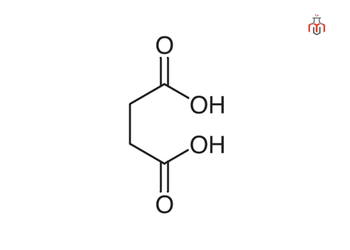
Succinic Acid is a naturally occurring dicarboxylic acid with the molecular formula C₄H₆O₄, also represented as (CH₂)₂(CO₂H)₂. Its structure contains a four carbon chain with two carboxylic acid groups and it normally occurs as a white odorless solid. In biological systems, its succinate form is an important intermediate in the citric acid (TCA) cycle, where it is converted to fumarate by succinate dehydrogenase and contributes to cellular energy metabolism. Also known as butanedioic acid, succinic acid is an important organic building block for the synthesis of numerous chemical derivatives and industrial materials.
CAS No.: 110-15-6
Synonyms: 1,4-Butanedioic acid, butanedioic acid.
| Physical Properties | |
| Chemical formula | C4H6O4 |
| IUPAC Name | Butanedioic acid |
| Molecular weight | 118.09 g/mol |
| Solubility | Soluble in water |
| Density | 1.56 g/cm3 at 20 °C |
| Appearance | White solid or crystals. |
| Storage | Store at room temperature |
| Chemical Properties | |
| Color | White or colorless |
| Physical State | Solid |
| Melting Point | 184-186 °C |
| Boiling Point | 235 °C |
| Ph | 2.7 (20 °C, 10 g/L in H2O) |
| Odor | Odorless |
| Pictograms : |  |
| Hazard Statements : | H318: Causes serious eye damage |
| Precautionary Statements: | P280: Wear protective gloves/eye protection P305+P351+P338: IF IN EYES: Rinse cautiously with water for several minutes. Remove contact lenses, if present and easy to do. Continue rinsing P310: Immediately call a POISON CENTER/doctor |
Succinic Acid is a naturally occurring dicarboxylic acid with the molecular formula C₄H₆O₄, also represented as (CH₂)₂(CO₂H)₂. Its structure contains a four carbon chain with two carboxylic acid groups and it normally occurs as a white odorless solid. In biological systems, its succinate form is an important intermediate in the citric acid (TCA) cycle, where it is converted to fumarate by succinate dehydrogenase and contributes to cellular energy metabolism. Also known as butanedioic acid, succinic acid is an important organic building block for the synthesis of numerous chemical derivatives and industrial materials.
CAS No.: 110-15-6
Synonyms: 1,4-Butanedioic acid, butanedioic acid.
| Physical Properties | |
| Chemical formula | C4H6O4 |
| IUPAC Name | Butanedioic acid |
| Molecular weight | 118.09 g/mol |
| Solubility | Soluble in water |
| Density | 1.56 g/cm3 at 20 °C |
| Appearance | White solid or crystals. |
| Storage | Store at room temperature |
| Chemical Properties | |
| Color | White or colorless |
| Physical State | Solid |
| Melting Point | 184-186 °C |
| Boiling Point | 235 °C |
| Ph | 2.7 (20 °C, 10 g/L in H2O) |
| Odor | Odorless |
| Pictograms : | |
| Hazard Statements : | H318: Causes serious eye damage |
| Precautionary Statements: | P280: Wear protective gloves/eye protection P305+P351+P338: IF IN EYES: Rinse cautiously with water for several minutes. Remove contact lenses, if present and easy to do. Continue rinsing P310: Immediately call a POISON CENTER/doctor |
