

N-Phenylanthranilic Acid is also known as Fenamic acid. It is an aromatic organic compound belonging to the aminobenzoic acid family and is the N-phenyl derivative of anthranilic acid. It serves as the parent scaffold for fenamate NSAIDs such as mefenamic acid, flufenamic acid, tolfenamic acid and meclofenamic acid. It is also used as an intermediate in heterocyclic synthesis, including acridone derivatives. It typically appears as a white to pale yellow crystalline solid with limited water solubility but good solubility in organic solvents like ethanol and acetone. It exhibits both acidic and basic character and shows biological activity such as ion channel modulation.
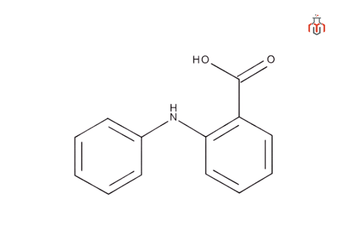
CAS No.: 91-40-7
Synonyms: Diphenylamine-2-carboxylic Acid, 2-Anilinobenzoic Acid, 2-(Phenylamino)benzoic acid.
| Physical Properties | |
| Chemical formula | C13H11NO2 |
| IUPAC Name | 2-anilinobenzoic acid |
| Molecular weight | 213.24 g/mol |
| Solubility | Poorly soluble in water and Soluble in methanol and acetone. |
| Appearance | White to off-white or beige powder |
| Storage | Store at room temperature |
| Chemical Properties | |
| Color | White to yellow to grey to brown |
| Physical State | Solid |
| Melting Point | 187 °C |
| Odor | Odorless |
| Pictograms : |   |
| Hazard Statements : | H315: Causes skin irritation H319: Causes serious eye irritation H335: May cause respiratory irritation |
| Precautionary Statements: | P261: Avoid breathing dust/fume/gas/mist/vapours/spray P305+P351+P338:IF IN EYES: Rinse cautiously with water for several minutes. Remove contact lenses, if present and easy to do. Continue rinsing |
N-Phenylanthranilic Acid is also known as Fenamic acid. It is an aromatic organic compound belonging to the aminobenzoic acid family and is the N-phenyl derivative of anthranilic acid. It serves as the parent scaffold for fenamate NSAIDs such as mefenamic acid, flufenamic acid, tolfenamic acid and meclofenamic acid. It is also used as an intermediate in heterocyclic synthesis, including acridone derivatives. It typically appears as a white to pale yellow crystalline solid with limited water solubility but good solubility in organic solvents like ethanol and acetone. It exhibits both acidic and basic character and shows biological activity such as ion channel modulation.
CAS No.: 91-40-7
Synonyms: Diphenylamine-2-carboxylic Acid, 2-Anilinobenzoic Acid, 2-(Phenylamino)benzoic acid.
| Physical Properties | |
| Chemical formula | C13H11NO2 |
| IUPAC Name | 2-anilinobenzoic acid |
| Molecular weight | 213.24 g/mol |
| Solubility | Poorly soluble in water and Soluble in methanol and acetone. |
| Appearance | White to off-white or beige powder |
| Storage | Store at room temperature |
| Chemical Properties | |
| Color | White to yellow to grey to brown |
| Physical State | Solid |
| Melting Point | 187 °C |
| Odor | Odorless |
| Pictograms : | |
| Hazard Statements : | H315: Causes skin irritation H319: Causes serious eye irritation H335: May cause respiratory irritation |
| Precautionary Statements: | P261: Avoid breathing dust/fume/gas/mist/vapours/spray P305+P351+P338:IF IN EYES: Rinse cautiously with water for several minutes. Remove contact lenses, if present and easy to do. Continue rinsing |
