

Manganese Chloride Tetrahydrate is an inorganic manganese salt with the manganese chloride tetrahydrate formula MnCl₂·4H₂O. It is the most common hydrated form of manganese(II) chloride and typically appears as pale pink crystals, a characteristic of high-spin manganese(II) compounds. The compound dissolves readily in water and contains four molecules of water of crystallization within its crystal structure. Manganese chloride tetrahydrate has also been studied as an oral magnetic resonance imaging (MRI) contrast agent and is recognized as a manganese coordination compound with nutraceutical significance.
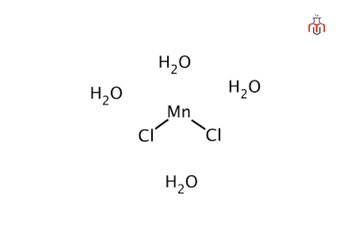
CAS No.: 13446-34-9
Synonyms: Manganese(2+) chloride tetrahydrate, Manganese(II) chloride tetrahydrate.
| Physical Properties | |
| Chemical formula | Cl2H8MnO4 |
| IUPAC Name | dichloromanganese;tetrahydrate |
| Molecular weight | 197.90 g/mol |
| Solubility | Soluble in water |
| Density | 2.01 g/cm3 |
| Appearance | Pale pink to pink crystalline powder |
| Storage | Store at room temperature |
| Chemical Properties | |
| Color | Pink |
| Physical State | Solid |
| Melting Point | 58 °C |
| Boiling Point | 1,225 °C |
| Ph value | 4-6 |
| Odor | Odorless |
| Pictograms : |    |
| Hazard Statements : | H301: Toxic if swallowed. H318: Causes serious eye damage. H373: May cause damage to organs (brain) through prolonged or repeated exposure (if inhaled). |
| Precautionary Statements: | P260: Do not breathe dust/fume/gas/mist/vapours/spray. P280: Wear protective gloves/eye protection/face protection. P301+P310: IF SWALLOWED: Immediately call a POISON CENTER/doctor. P305+P351+P338: IF IN EYES: Rinse cautiously with water for several minutes. Remove contact lenses, if present and easy to do. Continue rinsing. P308+P313: IF exposed or concerned: Get medical advice/attention. |
Manganese Chloride Tetrahydrate is an inorganic manganese salt with the manganese chloride tetrahydrate formula MnCl₂·4H₂O. It is the most common hydrated form of manganese(II) chloride and typically appears as pale pink crystals, a characteristic of high-spin manganese(II) compounds. The compound dissolves readily in water and contains four molecules of water of crystallization within its crystal structure. Manganese chloride tetrahydrate has also been studied as an oral magnetic resonance imaging (MRI) contrast agent and is recognized as a manganese coordination compound with nutraceutical significance.
CAS No.: 13446-34-9
Synonyms: Manganese(2+) chloride tetrahydrate, Manganese(II) chloride tetrahydrate.
| Physical Properties | |
| Chemical formula | Cl2H8MnO4 |
| IUPAC Name | dichloromanganese;tetrahydrate |
| Molecular weight | 197.90 g/mol |
| Solubility | Soluble in water |
| Density | 2.01 g/cm3 |
| Appearance | Pale pink to pink crystalline powder |
| Storage | Store at room temperature |
| Chemical Properties | |
| Color | Pink |
| Physical State | Solid |
| Melting Point | 58 °C |
| Boiling Point | 1,225 °C |
| Ph value | 4-6 |
| Odor | Odorless |
| Pictograms : | |
| Hazard Statements : | H301: Toxic if swallowed. H318: Causes serious eye damage. H373: May cause damage to organs (brain) through prolonged or repeated exposure (if inhaled). |
| Precautionary Statements: | P260: Do not breathe dust/fume/gas/mist/vapours/spray. P280: Wear protective gloves/eye protection/face protection. P301+P310: IF SWALLOWED: Immediately call a POISON CENTER/doctor. P305+P351+P338: IF IN EYES: Rinse cautiously with water for several minutes. Remove contact lenses, if present and easy to do. Continue rinsing. P308+P313: IF exposed or concerned: Get medical advice/attention. |
