

7-Hydroxycoumarin is also known as Umbelliferone, is a natural hydroxycoumarin of the coumarin family. It is found in various medicinal plants, especially in the Apiaceae (Umbelliferae) family. It is a yellow-white crystalline solid, slightly soluble in hot water, and readily soluble in ethanol. It has strong ultraviolet (UV) absorption and bright blue fluorescence under UV light, making it a well-known naturally fluorescent compound. It is also known as a plant metabolite and food component with reported antioxidant and antimutagenic properties.
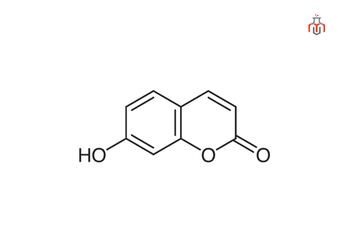
CAS No.: 93-35-6
Synonyms: Umbelliferone, 7-hydroxy-2H-chromen-2-one, and skimmetin
| Physical Properties | |
| Chemical formula | C9H6O3 |
| IUPAC Name | 7-hydroxychromen-2-one |
| Molecular weight | 162.14 g/mol |
| Solubility | Slightly soluble in water |
| Appearance | White to Light yellow powder to crystals |
| Storage | Room Temperature (Recommended in a cool and dark place, <15°C) |
| Chemical Properties | |
| Color | Off-white to beige-brownish |
| Physical State | Solid |
| Melting Point | 230 °C |
| Odor | Odorless |
Fluorescent Probes & Bioimaging: 7-Hydroxycoumarin is used as a fluorescent dye for labelling and visualising cells, biomolecules, and intracellular structures. It is also used as a precursor for fluorescent probes used in detecting cyanide ions, hydrogen peroxide, and other biologically important analytes in vitro and in vivo.
Enzyme Assays: 7-Hydroxycoumarin is widely used as a fluorometric enzyme substrate in enzyme activity, inhibition and biochemical pathway assays with high sensitivity.
Molecularly Imprinted Polymers: It is used as a template molecule to prepare molecularly imprinted polymers for selective analysis of plant-derived compounds.
Analytical Chemistry: It serves as an analytical reference standard for the determination of Umbelliferone in plant samples using reversed-phase HPLC and other chromatographic methods.
Organic & Pharmaceutical Synthesis: It is an important intermediate for synthesizing novobiocin derivatives, (+)-decursinol, (+)-angelmarin, and other biologically active molecules.
Natural Product Research: It is widely used in phytochemical studies as a reference compound for the identification and quantification of coumarin derivatives in medicinal plants.
Optical Materials Research: It is used in the preparation of coumarin-based polymers for optical data storage and other photonic material applications.
| Pictograms : |  |
| Hazard Statements : | H315: Causes skin irritation. H319: Causes serious eye irritation. |
| Precautionary statements : | P264: Wash skin thoroughly after handling. P280: Wear protective gloves/ eye protection/ face protection. P302 + P352: IF ON SKIN: Wash with plenty of water. P337 + P313: If eye irritation persists: Get medical advice/ attention. P305 + P351 + P338: IF IN EYES: Rinse cautiously with water for several minutes. Remove contact lenses, if present and easy to do. Continue rinsing. P362 + P364: Take off contaminated clothing and wash it before reuse. P332 + P313: If skin irritation occurs: Get medical advice/ attention.
|
7-Hydroxycoumarin is also known as Umbelliferone, is a natural hydroxycoumarin of the coumarin family. It is found in various medicinal plants, especially in the Apiaceae (Umbelliferae) family. It is a yellow-white crystalline solid, slightly soluble in hot water, and readily soluble in ethanol. It has strong ultraviolet (UV) absorption and bright blue fluorescence under UV light, making it a well-known naturally fluorescent compound. It is also known as a plant metabolite and food component with reported antioxidant and antimutagenic properties.
CAS No.: 93-35-6
Synonyms: Umbelliferone, 7-hydroxy-2H-chromen-2-one, and skimmetin
| Physical Properties | |
| Chemical formula | C9H6O3 |
| IUPAC Name | 7-hydroxychromen-2-one |
| Molecular weight | 162.14 g/mol |
| Solubility | Slightly soluble in water |
| Appearance | White to Light yellow powder to crystals |
| Storage | Room Temperature (Recommended in a cool and dark place, <15°C) |
| Chemical Properties | |
| Color | Off-white to beige-brownish |
| Physical State | Solid |
| Melting Point | 230 °C |
| Odor | Odorless |
Fluorescent Probes & Bioimaging: 7-Hydroxycoumarin is used as a fluorescent dye for labelling and visualising cells, biomolecules, and intracellular structures. It is also used as a precursor for fluorescent probes used in detecting cyanide ions, hydrogen peroxide, and other biologically important analytes in vitro and in vivo.
Enzyme Assays: 7-Hydroxycoumarin is widely used as a fluorometric enzyme substrate in enzyme activity, inhibition and biochemical pathway assays with high sensitivity.
Molecularly Imprinted Polymers: It is used as a template molecule to prepare molecularly imprinted polymers for selective analysis of plant-derived compounds.
Analytical Chemistry: It serves as an analytical reference standard for the determination of Umbelliferone in plant samples using reversed-phase HPLC and other chromatographic methods.
Organic & Pharmaceutical Synthesis: It is an important intermediate for synthesizing novobiocin derivatives, (+)-decursinol, (+)-angelmarin, and other biologically active molecules.
Natural Product Research: It is widely used in phytochemical studies as a reference compound for the identification and quantification of coumarin derivatives in medicinal plants.
Optical Materials Research: It is used in the preparation of coumarin-based polymers for optical data storage and other photonic material applications.
| Pictograms : | |
| Hazard Statements : | H315: Causes skin irritation. H319: Causes serious eye irritation. |
| Precautionary statements : | P264: Wash skin thoroughly after handling. P280: Wear protective gloves/ eye protection/ face protection. P302 + P352: IF ON SKIN: Wash with plenty of water. P337 + P313: If eye irritation persists: Get medical advice/ attention. P305 + P351 + P338: IF IN EYES: Rinse cautiously with water for several minutes. Remove contact lenses, if present and easy to do. Continue rinsing. P362 + P364: Take off contaminated clothing and wash it before reuse. P332 + P313: If skin irritation occurs: Get medical advice/ attention.
|
