

Tetrazolium Violet is an organic tetrazolium salt supplied as a chloride salt, containing tetrazolium violet as the active cation. It is a cell-permeable, positively charged dye that is reduced by metabolically active cells to form water-insoluble formazan, resulting in a visible color change. This property makes it useful for indicating cellular metabolic activity and redox potential.
The dye is reactive to intracellular reduction processes and is widely applied in microbiology, biochemistry, and cell biology research. It has also been reported to show antineoplastic and apoptosis-inducing properties which support its use in biomedical research.
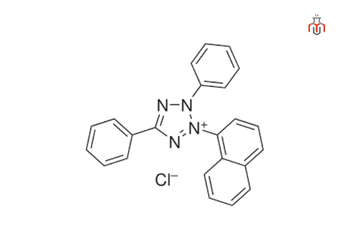
CAS No.: 1719-71-7
Synonyms: Tetrazolium, TETRAZOLIUM VIOLET, VIOLET TETRAZOLIUM, TetrazoliumVioletGr
| Physical Properties | |
| Chemical formula | C23H17ClN4 |
| IUPAC Name | 2-naphthalen-1-yl-3,5-diphenyltetrazol-2-ium chloride |
| Molecular weight | 384.9 g/mol |
| Solubility | Soluble in water, ethanol, and methanol |
| Appearance | White to light yellow to light orange powder to crystalline |
| Storage | Store at Room Temperature |
| Chemical Properties | |
| Color | Yellow brown or tan |
| Physical State | Solid |
| Melting Point | 245 – 250° C |
| λmax | 244 nm |
| Odor | Odorless |
| Pictograms : |  |
| Hazard Statements : | H228: Flammable solid H315: Causes skin irritation H319: Causes serious eye irritation H335: May cause respiratory irritation
|
| Precautionary statements : | P264: Wash face, hands, and any exposed skin thoroughly after handling. P280: Wear protective gloves/protective clothing/eye protection/face protection. P261: Avoid breathing dust/fume/gas/mist/vapors/spray. P271: Use only outdoors or in a well-ventilated area. P210: Keep away from heat, hot surfaces, sparks, open flames, and other ignition sources. No smoking. P240: Ground and bond container and receiving equipment. P241: Use explosion-proof electrical/ventilating/lighting equipment.
|
Tetrazolium Violet is an organic tetrazolium salt supplied as a chloride salt, containing tetrazolium violet as the active cation. It is a cell-permeable, positively charged dye that is reduced by metabolically active cells to form water-insoluble formazan, resulting in a visible color change. This property makes it useful for indicating cellular metabolic activity and redox potential.
The dye is reactive to intracellular reduction processes and is widely applied in microbiology, biochemistry, and cell biology research. It has also been reported to show antineoplastic and apoptosis-inducing properties which support its use in biomedical research.
CAS No.: 1719-71-7
Synonyms: Tetrazolium, TETRAZOLIUM VIOLET, VIOLET TETRAZOLIUM, TetrazoliumVioletGr
| Physical Properties | |
| Chemical formula | C23H17ClN4 |
| IUPAC Name | 2-naphthalen-1-yl-3,5-diphenyltetrazol-2-ium chloride |
| Molecular weight | 384.9 g/mol |
| Solubility | Soluble in water, ethanol, and methanol |
| Appearance | White to light yellow to light orange powder to crystalline |
| Storage | Store at Room Temperature |
| Chemical Properties | |
| Color | Yellow brown or tan |
| Physical State | Solid |
| Melting Point | 245 – 250° C |
| λmax | 244 nm |
| Odor | Odorless |
| Pictograms : | |
| Hazard Statements : | H228: Flammable solid H315: Causes skin irritation H319: Causes serious eye irritation H335: May cause respiratory irritation
|
| Precautionary statements : | P264: Wash face, hands, and any exposed skin thoroughly after handling. P280: Wear protective gloves/protective clothing/eye protection/face protection. P261: Avoid breathing dust/fume/gas/mist/vapors/spray. P271: Use only outdoors or in a well-ventilated area. P210: Keep away from heat, hot surfaces, sparks, open flames, and other ignition sources. No smoking. P240: Ground and bond container and receiving equipment. P241: Use explosion-proof electrical/ventilating/lighting equipment.
|
