

Sulfobromophthalein Sodium, also known as Bromsulfalein Sodium or Bromosulfophthalein Sodium, is a synthetic brominated sulfonphthalein dye historically used as a diagnostic agent for evaluating hepatic function. It belongs to the class of anionic phthalein dyes and exhibits characteristic color changes depending on pH and chemical environment. The compound is supplied as a sodium salt to improve water solubility and handling characteristics. It is widely used as a laboratory reagent in biochemical and analytical research due to its dye properties and compatibility with different analytical methods.
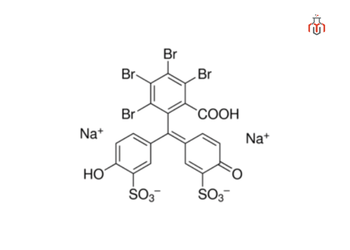
CAS No.- 71-67-0
Synonyms: Bromsulphthalein; Bromosulfophthalein; Bromosulphophthalein; BSP; Sulfobromophthalein
| Physical Properties | |
| Chemical formula | C20H8Br4Na2O10S2 |
| IUPAC Name | disodium;2-hydroxy-5-[4,5,6,7-tetrabromo-1-(4-hydroxy-3-sulfonatophenyl)-3-oxo-2-benzofuran-1-yl]benzenesulfonate |
| Molecular weight | 838.0 g/mol |
| Appearance | Light brown crystalline powder |
| Storage | Store at room temperature |
| Chemical Properties | |
| Color | White to light gray |
| Physical State | Solid at 20 °C |
| λmax | 575.0 – 581.0 nm |
| Solubility | Soluble in water |
| Odor | Odorless |
| Pictograms : |  |
| Hazard Statements : | H334: May cause allergy or asthma symptoms or breathing difficulties if inhaled. H317 May cause an allergic skin reaction |
| Precautionary statements : | P101: If medical advice is needed, have product container or label at hand. P102: Keep out of reach of children. P103: Read label before use. P261: Avoid breathing dust/fume/gas/mist/vapours/spray. P280: Wear protective gloves. P284: [In case of inadequate ventilation] wear respiratory protection. P342+P311: If experiencing respiratory symptoms: Call a POISON CENTER/doctor. P501: Dispose of contents/container in accordance with local/regional/national/international regulations. |
Sulfobromophthalein Sodium, also known as Bromsulfalein Sodium or Bromosulfophthalein Sodium, is a synthetic brominated sulfonphthalein dye historically used as a diagnostic agent for evaluating hepatic function. It belongs to the class of anionic phthalein dyes and exhibits characteristic color changes depending on pH and chemical environment. The compound is supplied as a sodium salt to improve water solubility and handling characteristics. It is widely used as a laboratory reagent in biochemical and analytical research due to its dye properties and compatibility with different analytical methods.
CAS No.- 71-67-0
Synonyms: Bromsulphthalein; Bromosulfophthalein; Bromosulphophthalein; BSP; Sulfobromophthalein
| Physical Properties | |
| Chemical formula | C20H8Br4Na2O10S2 |
| IUPAC Name | disodium;2-hydroxy-5-[4,5,6,7-tetrabromo-1-(4-hydroxy-3-sulfonatophenyl)-3-oxo-2-benzofuran-1-yl]benzenesulfonate |
| Molecular weight | 838.0 g/mol |
| Appearance | Light brown crystalline powder |
| Storage | Store at room temperature |
| Chemical Properties | |
| Color | White to light gray |
| Physical State | Solid at 20 °C |
| λmax | 575.0 – 581.0 nm |
| Solubility | Soluble in water |
| Odor | Odorless |
| Pictograms : | |
| Hazard Statements : | H334: May cause allergy or asthma symptoms or breathing difficulties if inhaled. H317 May cause an allergic skin reaction |
| Precautionary statements : | P101: If medical advice is needed, have product container or label at hand. P102: Keep out of reach of children. P103: Read label before use. P261: Avoid breathing dust/fume/gas/mist/vapours/spray. P280: Wear protective gloves. P284: [In case of inadequate ventilation] wear respiratory protection. P342+P311: If experiencing respiratory symptoms: Call a POISON CENTER/doctor. P501: Dispose of contents/container in accordance with local/regional/national/international regulations. |
