

Nile Blue Sulfate is a basic oxazine dye and a highly fluorescent organic compound with excellent photostability. It is readily soluble in water and ethyl alcohol and exhibits strong fluorescence in the 670–740 nm spectral region, making it suitable for fluorescence-based detection and imaging. The dye possesses selective affinity for lipid-rich cellular components, enabling differential staining of biological tissues.
Nile Blue Sulfate stain is particularly effective for distinguishing melanins from lipofuscins and for staining neutral fats and lipids in histological specimens. Its fluorescence characteristics and selective staining behavior have established it as a valuable reagent for lipid histochemistry, fluorescence microscopy, and other biological and analytical research applications.
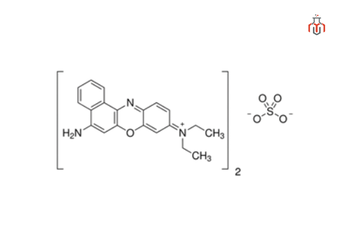
CAS No.: 3625-57-8
Synonyms: Nile Blue A, Nile Blue A sulfate, Nile Blue sulfate
| Physical and Chemical Properties | |
| Chemical formula | C40H40N6O6S |
| IUPAC Name | bis((5-aminobenzo[a]phenoxazin-9-ylidene)-diethylazanium);sulfate |
| Molecular weight | 732.8 g/mol |
| Solubility | Soluble in water |
| Color | Dark bluish black |
| Physical State | Powder |
| Melting Point | 300 °C |
| Storage | Store at room temperature |
| Pictograms : | 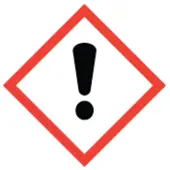 |
| Hazard Statements : | H302: Harmful if swallowed H315: Causes skin irritation H319: Causes serious eye irritation H335: May cause respiratory irritation |
| Precautionary statements : | P261: Avoid breathing dust/fume/gas/mist/vapours/spray. P264: Wash hands thoroughly after handling P270: Do not eat, drink or smoke when using this product. P271: Use only outdoors or in a well-ventilated area. P280: Wear protective gloves/protective clothing/eye protection/face protection |
Nile Blue Sulfate is a basic oxazine dye and a highly fluorescent organic compound with excellent photostability. It is readily soluble in water and ethyl alcohol and exhibits strong fluorescence in the 670–740 nm spectral region, making it suitable for fluorescence-based detection and imaging. The dye possesses selective affinity for lipid-rich cellular components, enabling differential staining of biological tissues.
Nile Blue Sulfate stain is particularly effective for distinguishing melanins from lipofuscins and for staining neutral fats and lipids in histological specimens. Its fluorescence characteristics and selective staining behavior have established it as a valuable reagent for lipid histochemistry, fluorescence microscopy, and other biological and analytical research applications.
CAS No.: 3625-57-8
Synonyms: Nile Blue A, Nile Blue A sulfate, Nile Blue sulfate
| Physical and Chemical Properties | |
| Chemical formula | C40H40N6O6S |
| IUPAC Name | bis((5-aminobenzo[a]phenoxazin-9-ylidene)-diethylazanium);sulfate |
| Molecular weight | 732.8 g/mol |
| Solubility | Soluble in water |
| Color | Dark bluish black |
| Physical State | Powder |
| Melting Point | 300 °C |
| Storage | Store at room temperature |
| Pictograms : | |
| Hazard Statements : | H302: Harmful if swallowed H315: Causes skin irritation H319: Causes serious eye irritation H335: May cause respiratory irritation |
| Precautionary statements : | P261: Avoid breathing dust/fume/gas/mist/vapours/spray. P264: Wash hands thoroughly after handling P270: Do not eat, drink or smoke when using this product. P271: Use only outdoors or in a well-ventilated area. P280: Wear protective gloves/protective clothing/eye protection/face protection |
