

Evans Blue is an azo dye, a synthetic compound that is a broad-spectrum dye used for biological staining, for studies of vascular permeability, and for biomedical research. It has a high affinity for serum albumin and has been used in the study of blood circulation, plasma volume, and blood vessel leakage. It is used to create a significant blue coloration in tissues where there is some leakage from the vasculature and is used in neuroscience and histology, cardiovascular research, and drug delivery studies.
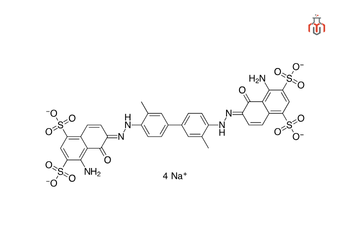
CAS No. : 314-13-6
Synonyms: T-1824, Direct Blue 53, Evans Blue Dye
| Physical Properties | |
| Chemical formula | C34H24N6Na4O14S4 |
| IUPAC Name | Tetrasodium(6E)-4-amino-6-[[4-[4-[(2E)-2-(8-amino-1-oxo-5,7-disulfonatonaphthalen-2-ylidene)hydrazinyl] -3-methylphenyl]-2-methylphenyl]hydrazinylidene]-5-oxonaphthalene-1,3-disulfonate |
| Molecular weight | 960.8 g/mol |
| Solubility | Soluble in water (10–50 mg/mL at 25 °C) |
| Appearance | Solid (Powder) |
| Chemical Properties | |
| Color | Dark Brown to Black |
| Physical State at 20 °C | Solid |
| Stability | Generally stable at room temperature |
| Charge | Anionic (negatively charged) |
| Exact Mass | 959.9824113 Da |
Histology and Biomedical Research
Fluorescence Imaging Applications
Neuroscience & Blood-Brain Barrier Research
Vascular Permeability & Cardiovascular Research
Muscle & Tissue Damage Studies
Pulmonary & Inflammation Studies
| Pictograms : |
|
| Hazard Statements : | H350 – May cause cancer. H301 – Toxic if swallowed. |
| Precautionary statements : | P264 – Wash skin thoroughly after handling. P270 – Do not eat, drink or smoke when using this product. P273 – Avoid release to the environment. P301 + P312 – IF SWALLOWED – Call a POISON CENTER or doctor/ physician if you feel unwell. P330 – Rinse mouth. P391 – Collect spillage. P501 – Dispose of contents/ container to an approved waste disposal plant. |
Evans Blue is an azo dye, a synthetic compound that is a broad-spectrum dye used for biological staining, for studies of vascular permeability, and for biomedical research. It has a high affinity for serum albumin and has been used in the study of blood circulation, plasma volume, and blood vessel leakage. It is used to create a significant blue coloration in tissues where there is some leakage from the vasculature and is used in neuroscience and histology, cardiovascular research, and drug delivery studies.
CAS No. : 314-13-6
Synonyms: T-1824, Direct Blue 53, Evans Blue Dye
| Physical Properties | |
| Chemical formula | C34H24N6Na4O14S4 |
| IUPAC Name | Tetrasodium(6E)-4-amino-6-[[4-[4-[(2E)-2-(8-amino-1-oxo-5,7-disulfonatonaphthalen-2-ylidene)hydrazinyl] -3-methylphenyl]-2-methylphenyl]hydrazinylidene]-5-oxonaphthalene-1,3-disulfonate |
| Molecular weight | 960.8 g/mol |
| Solubility | Soluble in water (10–50 mg/mL at 25 °C) |
| Appearance | Solid (Powder) |
| Chemical Properties | |
| Color | Dark Brown to Black |
| Physical State at 20 °C | Solid |
| Stability | Generally stable at room temperature |
| Charge | Anionic (negatively charged) |
| Exact Mass | 959.9824113 Da |
Histology and Biomedical Research
Fluorescence Imaging Applications
Neuroscience & Blood-Brain Barrier Research
Vascular Permeability & Cardiovascular Research
Muscle & Tissue Damage Studies
Pulmonary & Inflammation Studies
| Pictograms : |
|
| Hazard Statements : | H350 – May cause cancer. H301 – Toxic if swallowed. |
| Precautionary statements : | P264 – Wash skin thoroughly after handling. P270 – Do not eat, drink or smoke when using this product. P273 – Avoid release to the environment. P301 + P312 – IF SWALLOWED – Call a POISON CENTER or doctor/ physician if you feel unwell. P330 – Rinse mouth. P391 – Collect spillage. P501 – Dispose of contents/ container to an approved waste disposal plant. |