

Eosin B is a synthetic xanthene dye which is extensively used in microscopy, histology, cytology and biological research. It is characterized by a bluish-red color, which is useful as a counterstain to illuminate the cytoplasmic components, connective tissues, and extracellular components of biological specimens.
It is a member of the fluorescein class of dyes and is an acidic dye that readily stains materials with positive charges in the cells. It has good staining ability and good color contrast, which is useful for tissue examination, diagnostic pathology, microbiology, and laboratory research applications. It is also employed as a colorant and analytical reagent in other scientific applications, besides microscopy.
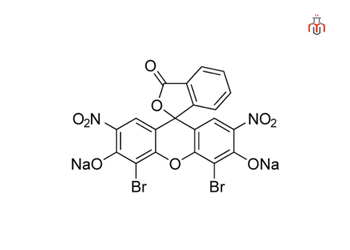
CAS NO. – 548-24-3
Synonyms – Eosin B; Eosin bluish
| Physical and Chemical Properties | |
| Chemical formula | C₂₀H₈Br₂N₂O₉ |
| IUPAC Name | disodium;4′,5′-dibromo-2′,7′-dinitro-3-oxospiro[2-benzofuran-1,9′-xanthene]-3′,6′-diolate |
| Molecular Weight | 624.1 g/mol |
| Physical State | Solid |
| Color | Very dark purple-red to dark brown |
| Stability | Stable. Incompatible with strong oxidizing agents. |
| Exact Mass | 623.82149 Da |
| Odor | Odorless |
| Melting Point | 295 °C |
| λmax | 514 nm |
| Storage | Room Temperature (Recommended in a cool and dark place, <15°C) |
| Parameter | Eosin B | Eosin Y |
| Overview | A dibromo-dinitro derivative of fluorescein used as a biological stain, fluorescent dye, and alternative histological counterstain. | A tetrabromo derivative of fluorescein and the most widely used eosin dye in histology, pathology, and cytology laboratories. |
| Chemical Formula | C₂₀H₈Br₂N₂O₉ | C₂₀H₈Br₄O₅ |
| CAS Number | 548-24-3 | 17372-87-1 |
| Molecular Weight | 580.09 g/mol | 647.89 g/mol |
| Appearance | Red to reddish-brown powder. | Red to dark red crystalline powder. |
| Color in Solution | Produces a bluish-red to crimson coloration. | Produces the characteristic pink to yellowish-red coloration associated with H&E staining. |
| Staining Characteristics | Offers a slightly cooler, bluish-red stain that can enhance contrast in certain tissue preparations. | Produces bright pink cytoplasmic staining and excellent differentiation of tissue structures. |
| Use in H&E Staining | Occasionally used as an alternative counterstain when a different color balance is desired. | Industry-standard counterstain for Hematoxylin and Eosin (H&E) staining. |
| Tissue Affinity | Stains cytoplasm, connective tissue components, and extracellular matrix structures. | Strongly stains cytoplasm, collagen, muscle fibers, erythrocytes, and connective tissues. |
| Pictograms : |  |
| Hazard Statements : | H318 – Causes serious eye damage |
| Precautionary statements : | P280 – Wear protective gloves/protective clothing/eye protection/face protection Response P305 + P351 + P338 – IF IN EYES: Rinse cautiously with water for several minutes. Remove contact lenses, if present, and easy to do. Continue rinsing P310 – Immediately call a POISON CENTER or doctor Storage P403 – Store in a well-ventilated place Disposal P501 – Dispose of contents/ container to an approved waste disposal plant |
Eosin B is a synthetic xanthene dye which is extensively used in microscopy, histology, cytology and biological research. It is characterized by a bluish-red color, which is useful as a counterstain to illuminate the cytoplasmic components, connective tissues, and extracellular components of biological specimens.
It is a member of the fluorescein class of dyes and is an acidic dye that readily stains materials with positive charges in the cells. It has good staining ability and good color contrast, which is useful for tissue examination, diagnostic pathology, microbiology, and laboratory research applications. It is also employed as a colorant and analytical reagent in other scientific applications, besides microscopy.
CAS NO. – 548-24-3
Synonyms – Eosin B; Eosin bluish
| Physical and Chemical Properties | |
| Chemical formula | C₂₀H₈Br₂N₂O₉ |
| IUPAC Name | disodium;4′,5′-dibromo-2′,7′-dinitro-3-oxospiro[2-benzofuran-1,9′-xanthene]-3′,6′-diolate |
| Molecular Weight | 624.1 g/mol |
| Physical State | Solid |
| Color | Very dark purple-red to dark brown |
| Stability | Stable. Incompatible with strong oxidizing agents. |
| Exact Mass | 623.82149 Da |
| Odor | Odorless |
| Melting Point | 295 °C |
| λmax | 514 nm |
| Storage | Room Temperature (Recommended in a cool and dark place, <15°C) |
| Parameter | Eosin B | Eosin Y |
| Overview | A dibromo-dinitro derivative of fluorescein used as a biological stain, fluorescent dye, and alternative histological counterstain. | A tetrabromo derivative of fluorescein and the most widely used eosin dye in histology, pathology, and cytology laboratories. |
| Chemical Formula | C₂₀H₈Br₂N₂O₉ | C₂₀H₈Br₄O₅ |
| CAS Number | 548-24-3 | 17372-87-1 |
| Molecular Weight | 580.09 g/mol | 647.89 g/mol |
| Appearance | Red to reddish-brown powder. | Red to dark red crystalline powder. |
| Color in Solution | Produces a bluish-red to crimson coloration. | Produces the characteristic pink to yellowish-red coloration associated with H&E staining. |
| Staining Characteristics | Offers a slightly cooler, bluish-red stain that can enhance contrast in certain tissue preparations. | Produces bright pink cytoplasmic staining and excellent differentiation of tissue structures. |
| Use in H&E Staining | Occasionally used as an alternative counterstain when a different color balance is desired. | Industry-standard counterstain for Hematoxylin and Eosin (H&E) staining. |
| Tissue Affinity | Stains cytoplasm, connective tissue components, and extracellular matrix structures. | Strongly stains cytoplasm, collagen, muscle fibers, erythrocytes, and connective tissues. |
| Pictograms : | |
| Hazard Statements : | H318 – Causes serious eye damage |
| Precautionary statements : | P280 – Wear protective gloves/protective clothing/eye protection/face protection Response P305 + P351 + P338 – IF IN EYES: Rinse cautiously with water for several minutes. Remove contact lenses, if present, and easy to do. Continue rinsing P310 – Immediately call a POISON CENTER or doctor Storage P403 – Store in a well-ventilated place Disposal P501 – Dispose of contents/ container to an approved waste disposal plant |
