

Basic Violet 2, also known as New Fuchsin (CI 42520), is a synthetic basic dye of the triamino triphenylmethane dye family. It is commonly used in the laboratory of microbiology, histology, pathology, and life sciences for staining of cells, tissues, and microorganisms for microscopic analysis.
It has excellent staining performance and strong color intensity that gives a bright red to magenta color, which provides good contrast in various biological staining techniques. It is commonly used in Ziehl-Neelsen staining, Gram staining, and Schiff reagent-based techniques employed in research, diagnostic, and educational laboratories.
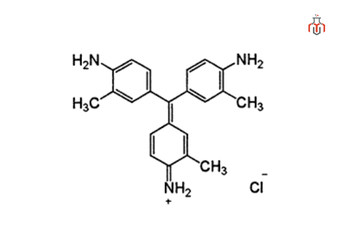
CAS NO. 3248-91-7
Synonyms- New fuchsin, Magenta III, Neofuchsin
| Physical Properties | |
| Chemical formula | C22H24ClN3 |
| IUPAC Name | 4-[(4-amino-3-methylphenyl)-(4-imino-3-methylcyclohexa-2,5-dien-1-ylidene) methyl]-2-methylaniline;hydrochloride |
| Molecular weight | 365.91 g/mol |
| Solubility | Soluble in water (20g/L) |
| Density | 1.147 g/ml (20 °C) |
| pH | 4.51 (saturated aqueous solution at 20 °C) |
| Chemical Properties | |
| Color | Dark green |
| Physical state | Powder |
| Melting Point | >250℃ |
| Boiling Point | 300℃ |
| Vapor pressure | 0Pa at 25℃ |
| Odor | Odorless |
| LogP | 1.537 |
| Pictograms : |   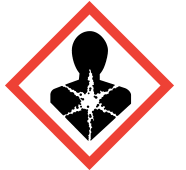 |
| Hazard Statements : | H315: Causes skin irritation H319: Causes serious eye irritation H335: May cause respiratory irritation H350: May cause cancer H410: Very toxic to aquatic life with long-lasting effects
|
| Precautionary statements : | P201: Obtain special instructions before use. P202: Do not handle until all safety precautions have been read and understood. P273: Avoid release to the environment. P302+P352 IF ON SKIN: wash with plenty of soap and water. P305+P351+P338 IF IN EYES: Rinse cautiously with water for several minutes. Remove contact lenses, if present and easy to do. Continuerinsing. P308+P313: If exposed or concerned: Get medical advice/attention. |
Basic Violet 2, also known as New Fuchsin (CI 42520), is a synthetic basic dye of the triamino triphenylmethane dye family. It is commonly used in the laboratory of microbiology, histology, pathology, and life sciences for staining of cells, tissues, and microorganisms for microscopic analysis.
It has excellent staining performance and strong color intensity that gives a bright red to magenta color, which provides good contrast in various biological staining techniques. It is commonly used in Ziehl-Neelsen staining, Gram staining, and Schiff reagent-based techniques employed in research, diagnostic, and educational laboratories.
CAS NO. 3248-91-7
Synonyms- New fuchsin, Magenta III, Neofuchsin
| Physical Properties | |
| Chemical formula | C22H24ClN3 |
| IUPAC Name | 4-[(4-amino-3-methylphenyl)-(4-imino-3-methylcyclohexa-2,5-dien-1-ylidene) methyl]-2-methylaniline;hydrochloride |
| Molecular weight | 365.91 g/mol |
| Solubility | Soluble in water (20g/L) |
| Density | 1.147 g/ml (20 °C) |
| pH | 4.51 (saturated aqueous solution at 20 °C) |
| Chemical Properties | |
| Color | Dark green |
| Physical state | Powder |
| Melting Point | >250℃ |
| Boiling Point | 300℃ |
| Vapor pressure | 0Pa at 25℃ |
| Odor | Odorless |
| LogP | 1.537 |
| Pictograms : | |
| Hazard Statements : | H315: Causes skin irritation H319: Causes serious eye irritation H335: May cause respiratory irritation H350: May cause cancer H410: Very toxic to aquatic life with long-lasting effects
|
| Precautionary statements : | P201: Obtain special instructions before use. P202: Do not handle until all safety precautions have been read and understood. P273: Avoid release to the environment. P302+P352 IF ON SKIN: wash with plenty of soap and water. P305+P351+P338 IF IN EYES: Rinse cautiously with water for several minutes. Remove contact lenses, if present and easy to do. Continuerinsing. P308+P313: If exposed or concerned: Get medical advice/attention. |
