

Azure C is a synthetic thiazine dye obtained through the oxidation of methylene blue. It is used extensively in histology, cytology, and biological research because of its strong metachromatic staining properties and fluorescence characteristics. It is highly affinity to nucleic acids and can be used for staining nuclei and other cell components in tissue and cell samples. It is also used in conventional staining applications, in fluorescence-based assays, in membrane permeability studies, in analytical chemistry, and in antibody-related research. It has also been the subject of recent scientific research for its potential to modulate tau protein aggregation and inhibit the formation of Aβ42 oligomers, which makes it a valuable research tool in studies of neurodegenerative diseases, such as Alzheimer’s disease.
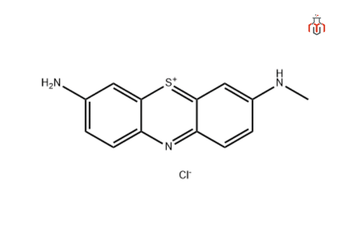
CAS NO.- 531-57-7
Synonyms- N-Methylthionine; Monomethylthionine; Methylene Azure C; Monomethylthionine chloride
| Physical and Chemical Properties | |
| Chemical formula | C13H12ClN3S |
| IUPAC Name | 7-methyliminophenothiazin-10-ium-3-amine chloride |
| Molecular weight | 277.7 g/mol |
| Solubility | Soluble in water |
| Color | Very Dark Green |
| Physical State | Solid |
| Appearance | Black Powder |
| Melting Point | 290 °C |
| Storage | Store at room temperature |
| Pictograms : |  |
| Hazard Statements : | H315: Causes skin irritation H319: Causes serious eye irritation H335: May cause respiratory irritation |
| Precautionary statements : | P305+P351+P338: IF IN EYES: Rinse cautiously with water for several minutes. Remove contact lenses, if present and easy to do. Continue rinsing. P302+P352: IF ON SKIN: wash with plenty of soap and water. P280: Wear protective gloves/protective clothing/eye protection/face protection P261: Avoid breathing dust/fume/gas/mist/vapours/spray |
Azure C is a synthetic thiazine dye obtained through the oxidation of methylene blue. It is used extensively in histology, cytology, and biological research because of its strong metachromatic staining properties and fluorescence characteristics. It is highly affinity to nucleic acids and can be used for staining nuclei and other cell components in tissue and cell samples. It is also used in conventional staining applications, in fluorescence-based assays, in membrane permeability studies, in analytical chemistry, and in antibody-related research. It has also been the subject of recent scientific research for its potential to modulate tau protein aggregation and inhibit the formation of Aβ42 oligomers, which makes it a valuable research tool in studies of neurodegenerative diseases, such as Alzheimer’s disease.
CAS NO.- 531-57-7
Synonyms- N-Methylthionine; Monomethylthionine; Methylene Azure C; Monomethylthionine chloride
| Physical and Chemical Properties | |
| Chemical formula | C13H12ClN3S |
| IUPAC Name | 7-methyliminophenothiazin-10-ium-3-amine chloride |
| Molecular weight | 277.7 g/mol |
| Solubility | Soluble in water |
| Color | Very Dark Green |
| Physical State | Solid |
| Appearance | Black Powder |
| Melting Point | 290 °C |
| Storage | Store at room temperature |
| Pictograms : | |
| Hazard Statements : | H315: Causes skin irritation H319: Causes serious eye irritation H335: May cause respiratory irritation |
| Precautionary statements : | P305+P351+P338: IF IN EYES: Rinse cautiously with water for several minutes. Remove contact lenses, if present and easy to do. Continue rinsing. P302+P352: IF ON SKIN: wash with plenty of soap and water. P280: Wear protective gloves/protective clothing/eye protection/face protection P261: Avoid breathing dust/fume/gas/mist/vapours/spray |
