

Acid Violet 19 is a synthetic, acidic dye of the triarylmethane dye family. It is known for its bright magenta color and excellent staining properties and is commonly used in histology, cytology, and biological research laboratories. The dye has a high affinity for different parts of cells and tissues and increases the contrast and visibility of cells under the microscope. It is widely used in special staining techniques such as Masson’s Trichrome and Van Gieson staining, which allow the differentiation of muscle fibers, connective tissues, cytoplasm, and other structural elements. It has a high level of capacity to stain tissues in a clear and distinct way, which makes it a valuable tool for tissue analysis, disease diagnosis, and biomedical research.
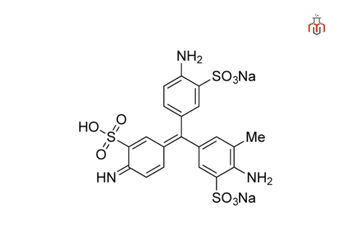
CAS No.- 3244-88-0
Synonyms- ACID FUCHSIN, ACID FUCHSINE, RUBIN S, RUBINE S, FUCHSIN S
| Physical Properties | |
| Chemical formula | C20H17N3Na2O9S3 |
| IUPAC Name | sodium3-[bis(4-amino-3-sulfophenyl)methylidene]- 6-imino-5-methylcyclohexa-1,4-diene-1-sulfonic acid |
| Molecular weight | 564.6 g/mol |
| Solubility | Soluble in water |
| Appearance | Dark Green Powder |
| Storage | Store at Room Temperature |
| Chemical Properties | |
| Color | Dark green |
| Physical state | Solid |
| Melting Point | >250 °C |
| λmax | 546nm |
| Vapor Pressure | 0Pa at 25°C |
| Odor | Odorless |
| Pictograms : | 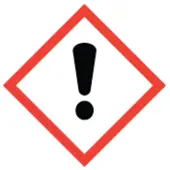 |
| Hazard Statements : | H315- Causes skin irritation H319- Causes serious eye irritation H335- May cause respiratory |
| Precautionary statements : | P264- Wash face, hands, and any exposed skin thoroughly after handling P280- Wear protective gloves/protective clothing/eye protection/face protection P261- Avoid breathing dust/fume/gas/mist/vapors/spray P271- Use only outdoors or in a well-ventilated area |
Acid Violet 19 is a synthetic, acidic dye of the triarylmethane dye family. It is known for its bright magenta color and excellent staining properties and is commonly used in histology, cytology, and biological research laboratories. The dye has a high affinity for different parts of cells and tissues and increases the contrast and visibility of cells under the microscope. It is widely used in special staining techniques such as Masson’s Trichrome and Van Gieson staining, which allow the differentiation of muscle fibers, connective tissues, cytoplasm, and other structural elements. It has a high level of capacity to stain tissues in a clear and distinct way, which makes it a valuable tool for tissue analysis, disease diagnosis, and biomedical research.
CAS No.- 3244-88-0
Synonyms- ACID FUCHSIN, ACID FUCHSINE, RUBIN S, RUBINE S, FUCHSIN S
| Physical Properties | |
| Chemical formula | C20H17N3Na2O9S3 |
| IUPAC Name | sodium3-[bis(4-amino-3-sulfophenyl)methylidene]- 6-imino-5-methylcyclohexa-1,4-diene-1-sulfonic acid |
| Molecular weight | 564.6 g/mol |
| Solubility | Soluble in water |
| Appearance | Dark Green Powder |
| Storage | Store at Room Temperature |
| Chemical Properties | |
| Color | Dark green |
| Physical state | Solid |
| Melting Point | >250 °C |
| λmax | 546nm |
| Vapor Pressure | 0Pa at 25°C |
| Odor | Odorless |
| Pictograms : | |
| Hazard Statements : | H315- Causes skin irritation H319- Causes serious eye irritation H335- May cause respiratory |
| Precautionary statements : | P264- Wash face, hands, and any exposed skin thoroughly after handling P280- Wear protective gloves/protective clothing/eye protection/face protection P261- Avoid breathing dust/fume/gas/mist/vapors/spray P271- Use only outdoors or in a well-ventilated area |
