

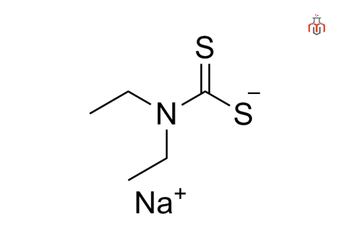
Sodium diethyldithiocarbamate trihydrate is an organosulfur compound and a hydrated dithiocarbamate salt with the chemical formula (C₂H₅)₂NCS₂Na·3H₂O. It generally occurs as a white to pale yellow solid and is freely soluble in water although gradual decomposition may occur in solution. The compound commonly crystallizes from aqueous media in its trihydrate form. A key characteristic of sodium diethyldithiocarbamate trihydrate is its strong chelating ability toward metal ions. Its dithiocarbamate group can coordinate with transition metals and form stable complexes. This metal-binding behavior makes the compound particularly valuable in laboratory research involving metal detection and biochemical studies of metal-dependent systems.
CAS No.: 20624-25-3
Synonyms: Ditiocarb sodium trihydrate, Dithiocarb trihydrate.
| Physical Properties | |
| Chemical formula | C5H16NNaO3S2 |
| IUPAC Name | sodium;N,N-diethylcarbamodithioate;trihydrate |
| Molecular weight | 225.3 g/mol |
| Solubility | Soluble in water |
| Density | 1.1 g/cm3 |
| Appearance | White to off-white powder or crystals |
| Storage | Store at room temperature |
| Chemical Properties | |
| Color | White |
| Physical State | Solid |
| Melting Point | 98 °C |
| Ph | 11.6 |
| Odor | Odorless |
| Pictograms : |   |
| Hazard Statements : | H302 Harmful if swallowed. H315 Causes skin irritation. H318 Causes serious eye damage. H410 Very toxic to aquatic life with long-lasting effects. |
| Precautionary Statements: | P273 Avoid release to the environment. P280 Wear protective gloves/eye protection. P302+P352 IF ON SKIN: Wash with plenty of water. P305+P351+P338 IF IN EYES: Rinse cautiously with water for several minutes. Remove contact. lenses, if present and easy to do. Continue rinsing. |
..
Sodium diethyldithiocarbamate trihydrate is an organosulfur compound and a hydrated dithiocarbamate salt with the chemical formula (C₂H₅)₂NCS₂Na·3H₂O. It generally occurs as a white to pale yellow solid and is freely soluble in water although gradual decomposition may occur in solution. The compound commonly crystallizes from aqueous media in its trihydrate form. A key characteristic of sodium diethyldithiocarbamate trihydrate is its strong chelating ability toward metal ions. Its dithiocarbamate group can coordinate with transition metals and form stable complexes. This metal-binding behavior makes the compound particularly valuable in laboratory research involving metal detection and biochemical studies of metal-dependent systems.
CAS No.: 20624-25-3
Synonyms: Ditiocarb sodium trihydrate, Dithiocarb trihydrate.
| Physical Properties | |
| Chemical formula | C5H16NNaO3S2 |
| IUPAC Name | sodium;N,N-diethylcarbamodithioate;trihydrate |
| Molecular weight | 225.3 g/mol |
| Solubility | Soluble in water |
| Density | 1.1 g/cm3 |
| Appearance | White to off-white powder or crystals |
| Storage | Store at room temperature |
| Chemical Properties | |
| Color | White |
| Physical State | Solid |
| Melting Point | 98 °C |
| Ph | 11.6 |
| Odor | Odorless |
| Pictograms : | |
| Hazard Statements : | H302 Harmful if swallowed. H315 Causes skin irritation. H318 Causes serious eye damage. H410 Very toxic to aquatic life with long-lasting effects. |
| Precautionary Statements: | P273 Avoid release to the environment. P280 Wear protective gloves/eye protection. P302+P352 IF ON SKIN: Wash with plenty of water. P305+P351+P338 IF IN EYES: Rinse cautiously with water for several minutes. Remove contact. lenses, if present and easy to do. Continue rinsing. |
..
