

Potassium Phosphate Tribasic is also known as tripotassium phosphate and is an inorganic potassium salt of phosphoric acid. It has the chemical formula K₃PO₄ and consists of three potassium ions (K⁺) and one phosphate ion (PO₄³⁻). It is readily soluble in water and has a strongly basic character with a 1% aqueous solution having a pH of about 11.8. The compound acts as a strong base and buffering agent and allow it to control pH by neutralizing acidic components. This property is important in biochemical research, where stable pH conditions helps enzymatic reactions and the stability of biological molecules. Potassium Phosphate Tribasic also shows high catalytic activity in bactericidal activity and transesterification reactions.
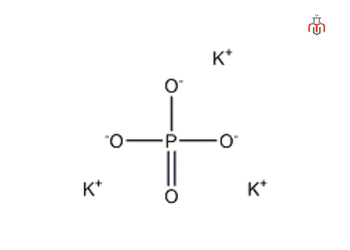
CAS No.: 7778-53-2
Synonyms: Potassium phosphate, tribasic, tripotassium phosphate.
| Physical Properties | |
| Chemical formula | K3PO4 |
| IUPAC Name | Potassium tetraoxidophosphate (3−) |
| Molecular weight | 212.27 g/mol |
| Solubility | Soluble in water |
| Density | 2.564 g/cm3 |
| Appearance | White powder or granules |
| Chemical Properties | |
| Color | White |
| Physical State | Solid |
| Melting Point | 1,380 °C |
| Ph Value | 11.9 (25 °C, 10 g/L) |
| Odor | Odorless |
Buffer Solutions- Potassium Phosphate Tribasic is used to adjust and maintain pH in biochemical and molecular biology experiments and it helps provide suitable conditions for enzymatic reactions.
Protein and Biological Research- It is used in lysis buffers for protein isolation from Gram-positive bacteria and in the preparation of high purity plasma membranes from plant materials such as Lilium davidii and Oryza sativa.
Chemical Synthesis- It functions as a strong base and catalyst particularly in transesterification reactions and other chemical transformations.
Fertilizer formulations- Potassium Phosphate Tribasic provides two vital nutrients that helps plant growth and development including potassium and phosphorus.
Pharmaceutical Formulations- It can be used into certain pharmaceutical preparations including intravenous formulations where potassium and phosphate are required for electrolyte management.
Food Processing- It is used as a food additive for pH control and for improving the texture and stability of some processed foods such as some dairy and baked goods.
Material Research and Manufacturing- It is used as a reagent in the synthesis and modification of metal-organic frameworks such as NU-1000. It also finds use in ceramic and glass manufacturing processes.
Water Treatment- Potassium Phosphate Tribasic has applications in processes of water treatment, including systems designed to control water chemistry and assist with the removal of certain metal contaminants.
| Pictograms : |   |
| Hazard Statements : | H318: Causes serious eye damage. H335: May cause respiratory irritation. |
| Precautionary Statements: | P261: Avoid breathing dust/fume/gas/mist/vapours/spray. P271: Use only outdoors or in a well-ventilated area. P280: Wear protective clothing, eye protection, face protection, protective gloves. P304+P340: IF INHALED: Remove person to fresh air and keep comfortable for breathing. P312: Call a POISON CENTRE or doctor if you feel unwell. P305+P351+P338: IF IN EYES: Rinse cautiously with water for several minutes. Remove contact lenses, if present and easy to do. Continue rinsing. P403+P233: Store in a well-ventilated place. Keep container tightly closed. |
Potassium Phosphate Tribasic is also known as tripotassium phosphate and is an inorganic potassium salt of phosphoric acid. It has the chemical formula K₃PO₄ and consists of three potassium ions (K⁺) and one phosphate ion (PO₄³⁻). It is readily soluble in water and has a strongly basic character with a 1% aqueous solution having a pH of about 11.8. The compound acts as a strong base and buffering agent and allow it to control pH by neutralizing acidic components. This property is important in biochemical research, where stable pH conditions helps enzymatic reactions and the stability of biological molecules. Potassium Phosphate Tribasic also shows high catalytic activity in bactericidal activity and transesterification reactions.
CAS No.: 7778-53-2
Synonyms: Potassium phosphate, tribasic, tripotassium phosphate.
| Physical Properties | |
| Chemical formula | K3PO4 |
| IUPAC Name | Potassium tetraoxidophosphate (3−) |
| Molecular weight | 212.27 g/mol |
| Solubility | Soluble in water |
| Density | 2.564 g/cm3 |
| Appearance | White powder or granules |
| Chemical Properties | |
| Color | White |
| Physical State | Solid |
| Melting Point | 1,380 °C |
| Ph Value | 11.9 (25 °C, 10 g/L) |
| Odor | Odorless |
Buffer Solutions- Potassium Phosphate Tribasic is used to adjust and maintain pH in biochemical and molecular biology experiments and it helps provide suitable conditions for enzymatic reactions.
Protein and Biological Research- It is used in lysis buffers for protein isolation from Gram-positive bacteria and in the preparation of high purity plasma membranes from plant materials such as Lilium davidii and Oryza sativa.
Chemical Synthesis- It functions as a strong base and catalyst particularly in transesterification reactions and other chemical transformations.
Fertilizer formulations- Potassium Phosphate Tribasic provides two vital nutrients that helps plant growth and development including potassium and phosphorus.
Pharmaceutical Formulations- It can be used into certain pharmaceutical preparations including intravenous formulations where potassium and phosphate are required for electrolyte management.
Food Processing- It is used as a food additive for pH control and for improving the texture and stability of some processed foods such as some dairy and baked goods.
Material Research and Manufacturing- It is used as a reagent in the synthesis and modification of metal-organic frameworks such as NU-1000. It also finds use in ceramic and glass manufacturing processes.
Water Treatment- Potassium Phosphate Tribasic has applications in processes of water treatment, including systems designed to control water chemistry and assist with the removal of certain metal contaminants.
| Pictograms : | |
| Hazard Statements : | H318: Causes serious eye damage. H335: May cause respiratory irritation. |
| Precautionary Statements: | P261: Avoid breathing dust/fume/gas/mist/vapours/spray. P271: Use only outdoors or in a well-ventilated area. P280: Wear protective clothing, eye protection, face protection, protective gloves. P304+P340: IF INHALED: Remove person to fresh air and keep comfortable for breathing. P312: Call a POISON CENTRE or doctor if you feel unwell. P305+P351+P338: IF IN EYES: Rinse cautiously with water for several minutes. Remove contact lenses, if present and easy to do. Continue rinsing. P403+P233: Store in a well-ventilated place. Keep container tightly closed. |
