

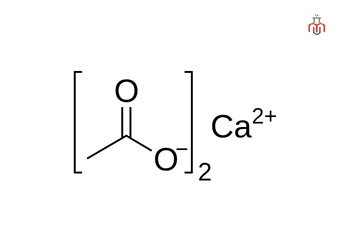
Calcium acetate is the calcium salt of acetic acid with the chemical formula Ca(C₂H₃O₂)₂. Also known as acetate of lime, it is an ionic compound composed of calcium cations (Ca²⁺) and acetate anions (C₂H₃O₂⁻) arranged in a crystalline lattice. It is normally a white, odorless crystalline powder, the monohydrate being the most common commercial form, as the anhydrous form is highly hygroscopic. Calcium acetate is a readily available source of calcium and is moderately to highly soluble in water. It is frequently used as a phosphate-binding agent in pharmaceutical preparations and as a calcium source in biochemical, analytical, and industrial applications.
CAS No.: 62-54-4
Synonyms: Calcium diacetate, Lime acetate.
| Physical Properties | |
| Chemical formula | C4H6CaO4 |
| IUPAC Name | calcium diacetate |
| Molecular weight | 158.17 g/mol |
| Solubility | Soluble in water |
| Density | 1.509 g/cm3 |
| Storage | Store at room temperature |
| Chemical Properties | |
| Color | White |
| Physical State | Solid |
| Melting Point | 160 °C |
| Ph | 8 |
| Odor | Slight acetic acid odor |
| Pictograms : | No information available |
| Hazard Statements : | No information available |
| Precautionary statements : | No information available |
Calcium acetate is the calcium salt of acetic acid with the chemical formula Ca(C₂H₃O₂)₂. Also known as acetate of lime, it is an ionic compound composed of calcium cations (Ca²⁺) and acetate anions (C₂H₃O₂⁻) arranged in a crystalline lattice. It is normally a white, odorless crystalline powder, the monohydrate being the most common commercial form, as the anhydrous form is highly hygroscopic. Calcium acetate is a readily available source of calcium and is moderately to highly soluble in water. It is frequently used as a phosphate-binding agent in pharmaceutical preparations and as a calcium source in biochemical, analytical, and industrial applications.
CAS No.: 62-54-4
Synonyms: Calcium diacetate, Lime acetate.
| Physical Properties | |
| Chemical formula | C4H6CaO4 |
| IUPAC Name | calcium diacetate |
| Molecular weight | 158.17 g/mol |
| Solubility | Soluble in water |
| Density | 1.509 g/cm3 |
| Storage | Store at room temperature |
| Chemical Properties | |
| Color | White |
| Physical State | Solid |
| Melting Point | 160 °C |
| Ph | 8 |
| Odor | Slight acetic acid odor |
| Pictograms : | No information available |
| Hazard Statements : | No information available |
| Precautionary statements : | No information available |
