

Calcein is a xanthene fluorescent dye that functions as a fluorochrome and is structurally related to fluoran compounds. It is also known as Fluorexon or Oftasceine, it is an orange crystalline compound with excitation and emission wavelengths of approximately 495 nm and 515 nm, respectively, producing bright green fluorescence. Calcein is a calcium-binding compound and has long been used as a fluorescent indicator in analytical and biological research. It also demonstrates self-quenching at high concentrations, a characteristic that is useful in fluorescence-based experimental studies. Due to its excellent fluorescence characteristics, it is widely used in research laboratories for analytical, biochemical and life science applications.
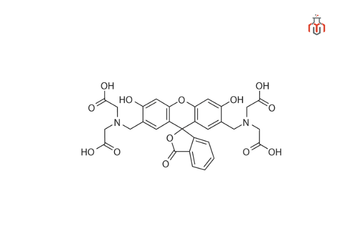
CAS No.: 1461-15-0
Synonyms: Fluorexon, Oftasceine, Bis[N,N−bis(carboxymethyl)aminomethyl]fluorescein.
| Physical Properties | |
| Chemical formula | C30H26N2O13 |
| IUPAC Name | -[[7′-[[bis(carboxymethyl)amino]methyl]-3′,6′-dihydroxy-3- oxospiro[2-benzofuran-1,9′-xanthene]-2′-yl]methyl-(carboxymethyl)amino]acetic acid |
| Molecular weight | 622.5 g/mol |
| Solubility | Slightly Soluble in water |
| Appearance | Yellow to orange-brown crystalline powder |
| Storage | Store at room temperature |
| Chemical Properties | |
| Color | Orange or Yellow-brown |
| Physical State | Solid |
| Melting Point | 200 °C |
| λmax | 494 nm |
| Odor | Odorless |
| Pictograms : |  |
| Hazard Statements : | H315: Causes skin irritation. H319: Causes serious eye irritation. H335: May cause respiratory irritation. H302+H312+H332: Harmful if swallowed, in contact with skin or if inhaled. |
| Precautionary statements : | P261: Avoid breathing dust/fume/gas/mist/vapors/spray P264: Wash thoroughly after handling. P270: Do not eat, drink or smoke when using this product. P271: Use only outdoors or in a well-ventilated area. P280: Wear protective gloves/protective clothing/eye protection/face protection/hearing protection. P301+P312: If swallowed: Call a poison center/doctor if you feel unwell. P302+P352: If on skin: Wash with plenty of water. P304+P340: If inhaled: Remove person to fresh air and keep comfortable for breathing. P305+P351+P338: If in eyes: Rinse cautiously with water for several minutes. Remove contact lenses, if present and easy to do. Continue rinsing. P332+P313: If skin irritation occurs: Get medical advice/attention. P362+P364: Take off contaminated clothing and wash it before reuse. P337+P313: If eye irritation persists: Get medical advice/attention. P403+P233: Store in a well-ventilated place. Keep container tightly closed. |
Calcein is a xanthene fluorescent dye that functions as a fluorochrome and is structurally related to fluoran compounds. It is also known as Fluorexon or Oftasceine, it is an orange crystalline compound with excitation and emission wavelengths of approximately 495 nm and 515 nm, respectively, producing bright green fluorescence. Calcein is a calcium-binding compound and has long been used as a fluorescent indicator in analytical and biological research. It also demonstrates self-quenching at high concentrations, a characteristic that is useful in fluorescence-based experimental studies. Due to its excellent fluorescence characteristics, it is widely used in research laboratories for analytical, biochemical and life science applications.
CAS No.: 1461-15-0
Synonyms: Fluorexon, Oftasceine, Bis[N,N−bis(carboxymethyl)aminomethyl]fluorescein.
| Physical Properties | |
| Chemical formula | C30H26N2O13 |
| IUPAC Name | -[[7′-[[bis(carboxymethyl)amino]methyl]-3′,6′-dihydroxy-3- oxospiro[2-benzofuran-1,9′-xanthene]-2′-yl]methyl-(carboxymethyl)amino]acetic acid |
| Molecular weight | 622.5 g/mol |
| Solubility | Slightly Soluble in water |
| Appearance | Yellow to orange-brown crystalline powder |
| Storage | Store at room temperature |
| Chemical Properties | |
| Color | Orange or Yellow-brown |
| Physical State | Solid |
| Melting Point | 200 °C |
| λmax | 494 nm |
| Odor | Odorless |
| Pictograms : | |
| Hazard Statements : | H315: Causes skin irritation. H319: Causes serious eye irritation. H335: May cause respiratory irritation. H302+H312+H332: Harmful if swallowed, in contact with skin or if inhaled. |
| Precautionary statements : | P261: Avoid breathing dust/fume/gas/mist/vapors/spray P264: Wash thoroughly after handling. P270: Do not eat, drink or smoke when using this product. P271: Use only outdoors or in a well-ventilated area. P280: Wear protective gloves/protective clothing/eye protection/face protection/hearing protection. P301+P312: If swallowed: Call a poison center/doctor if you feel unwell. P302+P352: If on skin: Wash with plenty of water. P304+P340: If inhaled: Remove person to fresh air and keep comfortable for breathing. P305+P351+P338: If in eyes: Rinse cautiously with water for several minutes. Remove contact lenses, if present and easy to do. Continue rinsing. P332+P313: If skin irritation occurs: Get medical advice/attention. P362+P364: Take off contaminated clothing and wash it before reuse. P337+P313: If eye irritation persists: Get medical advice/attention. P403+P233: Store in a well-ventilated place. Keep container tightly closed. |
