

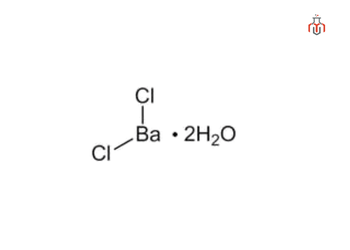
Barium Chloride Dihydrate is the dihydrate form of barium chloride. It is an inorganic compound with the chemical formula BaCl₂·2H₂O. It is one of the most common water-soluble barium salts and consists of barium chloride combined with two molecules of water of crystallization. It is appears as white to colorless crystalline crystals with a characteristic bitter, salty taste. It dissolves easily in water and is hygroscopic, so that it can be obtained in a stable hydrated crystalline form under normal conditions. It is a barium salt and an inorganic chloride with well-defined physicochemical properties that make it an important compound in laboratory and industrial chemistry.
CAS No.: 10326-27-9
Synonyms: DTXSID2020131, barium(2+) dichloride dihydrate
| Physical Properties | |
| Chemical formula | BaCl2H4O2 |
| IUPAC Name | barium(2+);dichloride;dihydrate |
| Molecular weight | 244.26 g/mol |
| Solubility | Soluble in water |
| Appearance | Clear & Colorless |
| Density | 3.86 |
| Storage | Store in a cool, dry, and well-ventilated area |
| Chemical Properties | |
| Color | White |
| Physical State | Solid |
| Melting Point | 963 °C |
| Boiling Point | 1,560 °C |
| Ph value | 5.2-8.2 (25 °C, 5%) |
| Odor | Odorless |
| Pictograms : |  |
| Hazard Statements : | H301: Toxic if swallowed. H332: Harmful if inhaled. |
| Precautionary statements : | P261: Avoid breathing dust/fume/gas/mist/vapours/spray. P264: Wash hands, forearms and face thoroughly after handling. P270: Do not eat, drink or smoke when using this product. P271: Use only outdoors or in a well-ventilated area.
|
Barium Chloride Dihydrate is the dihydrate form of barium chloride. It is an inorganic compound with the chemical formula BaCl₂·2H₂O. It is one of the most common water-soluble barium salts and consists of barium chloride combined with two molecules of water of crystallization. It is appears as white to colorless crystalline crystals with a characteristic bitter, salty taste. It dissolves easily in water and is hygroscopic, so that it can be obtained in a stable hydrated crystalline form under normal conditions. It is a barium salt and an inorganic chloride with well-defined physicochemical properties that make it an important compound in laboratory and industrial chemistry.
CAS No.: 10326-27-9
Synonyms: DTXSID2020131, barium(2+) dichloride dihydrate
| Physical Properties | |
| Chemical formula | BaCl2H4O2 |
| IUPAC Name | barium(2+);dichloride;dihydrate |
| Molecular weight | 244.26 g/mol |
| Solubility | Soluble in water |
| Appearance | Clear & Colorless |
| Density | 3.86 |
| Storage | Store in a cool, dry, and well-ventilated area |
| Chemical Properties | |
| Color | White |
| Physical State | Solid |
| Melting Point | 963 °C |
| Boiling Point | 1,560 °C |
| Ph value | 5.2-8.2 (25 °C, 5%) |
| Odor | Odorless |
| Pictograms : | |
| Hazard Statements : | H301: Toxic if swallowed. H332: Harmful if inhaled. |
| Precautionary statements : | P261: Avoid breathing dust/fume/gas/mist/vapours/spray. P264: Wash hands, forearms and face thoroughly after handling. P270: Do not eat, drink or smoke when using this product. P271: Use only outdoors or in a well-ventilated area.
|
