

Nile Blue Chloride (also referred to as Nile Blue A) is a synthetic phenothiazine dye. It is extensively used as a histological and fluorescent stain in biological research. It is widely used in microscopy, especially to visualize cellular components such as lipids and nuclei. The dye is known for its ability to differentiate various lipid structures. It stains neutral lipids and unsaturated glycerides pink, and acidic components such as fatty acids and phospholipids are purple-blue. This staining behavior makes it possible for researchers to identify and study different cellular materials. It has light-emitting properties, it is a fluorescence reference standard and is used along with histological staining. It can interact with biological molecules, making it useful for microscopy, imaging studies, and other research purposes.
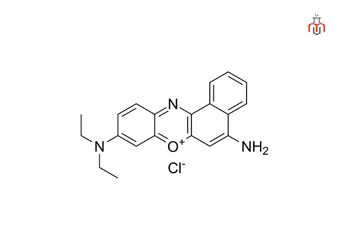
CAS NO.: 2381-13-7, 2381-85-3
Synonyms: Nile Blue A; Cresol Fast Violet, Basic Blue 12
| Physical Properties | |
| Chemical formula | C20H20CIN3O |
| IUPAC Name | (5-aminobenzo[a]phenoxazin-9-ylidene)-diethylazanium chloride |
| Molecular weight | 353.8 g/mol |
| Solubility | Soluble in water |
| Form | Powder |
| Storage | Store at Room Temperature |
| Chemical Properties | |
| Color | Dark Blue |
| Physical State | Solid |
| Melting Point | >250 °C |
| Odor | Odorless |
| Pictograms : | N/A |
| Hazard Statements : | N/A |
| Precautionary statements : | N/A |
Nile Blue Chloride (also referred to as Nile Blue A) is a synthetic phenothiazine dye. It is extensively used as a histological and fluorescent stain in biological research. It is widely used in microscopy, especially to visualize cellular components such as lipids and nuclei. The dye is known for its ability to differentiate various lipid structures. It stains neutral lipids and unsaturated glycerides pink, and acidic components such as fatty acids and phospholipids are purple-blue. This staining behavior makes it possible for researchers to identify and study different cellular materials. It has light-emitting properties, it is a fluorescence reference standard and is used along with histological staining. It can interact with biological molecules, making it useful for microscopy, imaging studies, and other research purposes.
CAS NO.: 2381-13-7, 2381-85-3
Synonyms: Nile Blue A; Cresol Fast Violet, Basic Blue 12
| Physical Properties | |
| Chemical formula | C20H20CIN3O |
| IUPAC Name | (5-aminobenzo[a]phenoxazin-9-ylidene)-diethylazanium chloride |
| Molecular weight | 353.8 g/mol |
| Solubility | Soluble in water |
| Form | Powder |
| Storage | Store at Room Temperature |
| Chemical Properties | |
| Color | Dark Blue |
| Physical State | Solid |
| Melting Point | >250 °C |
| Odor | Odorless |
| Pictograms : | N/A |
| Hazard Statements : | N/A |
| Precautionary statements : | N/A |
