

Nile Red is a synthetic fluorescent phenoxazone dye best known for its ability to selectively stain lipids and other hydrophobic structures. Because it is highly lipophilic, the dye readily accumulates in intracellular lipid droplets, neutral lipids, phospholipids, and biological membranes. In contrast to many other fluorescent dyes, it only becomes brightly fluorescent in a non-polar, lipid-rich environment and is non-fluorescent in water. This environment-sensitive behavior enables researchers to distinguish lipid-containing structures with better contrast.
It has been widely used in fluorescence microscopy and flow cytometry to visualize and quantify cellular lipids and is valuable in studies on lipid metabolism, lipid storage, and lipid-related diseases. It has also been used to stain SDS polyacrylamide gels, lysosomes, and organelles of the lysosome system in specialized laboratory applications. It is also used as a dye to detect and quantify microplastics in environmental samples by binding to many plastic particles and allowing their visualization using fluorescence imaging techniques, in addition to biomedical research. It is a reliable fluorescent stain for cell biology, biotechnology, environment & materials research, due to its sensitivity, stability, and selective affinity for lipids.
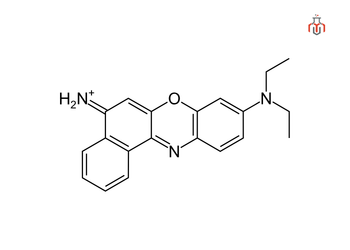
CAS No. : 7385-67-3
Synonyms: Nile Blue A Oxazone
| Physical Properties | |
| Chemical formula | C20H18N2O2 |
| IUPAC Name | 9-(diethylamino)benzo[a]phenoxazin-5-one |
| Molecular weight | 318.38 g/mol |
| Solubility | Methanol |
| Insoluble | Insoluble in water |
| Appearance | Dark green to brownish crystalline powder |
| Storage | Store at Room Temperature |
| Chemical Properties | |
| Color | Brown to very dark red |
| Physical state (20 °C) | Solid |
| Melting Point | 203-205 °C |
| λmax | 531 nm |
| Pictograms : |  |
| Hazard Statements : | H315: Causes skin irritation. |
| Precautionary statements : | P261: Avoid breathing dust/fumes. |
Nile Red is a synthetic fluorescent phenoxazone dye best known for its ability to selectively stain lipids and other hydrophobic structures. Because it is highly lipophilic, the dye readily accumulates in intracellular lipid droplets, neutral lipids, phospholipids, and biological membranes. In contrast to many other fluorescent dyes, it only becomes brightly fluorescent in a non-polar, lipid-rich environment and is non-fluorescent in water. This environment-sensitive behavior enables researchers to distinguish lipid-containing structures with better contrast.
It has been widely used in fluorescence microscopy and flow cytometry to visualize and quantify cellular lipids and is valuable in studies on lipid metabolism, lipid storage, and lipid-related diseases. It has also been used to stain SDS polyacrylamide gels, lysosomes, and organelles of the lysosome system in specialized laboratory applications. It is also used as a dye to detect and quantify microplastics in environmental samples by binding to many plastic particles and allowing their visualization using fluorescence imaging techniques, in addition to biomedical research. It is a reliable fluorescent stain for cell biology, biotechnology, environment & materials research, due to its sensitivity, stability, and selective affinity for lipids.
CAS No. : 7385-67-3
Synonyms: Nile Blue A Oxazone
| Physical Properties | |
| Chemical formula | C20H18N2O2 |
| IUPAC Name | 9-(diethylamino)benzo[a]phenoxazin-5-one |
| Molecular weight | 318.38 g/mol |
| Solubility | Methanol |
| Insoluble | Insoluble in water |
| Appearance | Dark green to brownish crystalline powder |
| Storage | Store at Room Temperature |
| Chemical Properties | |
| Color | Brown to very dark red |
| Physical state (20 °C) | Solid |
| Melting Point | 203-205 °C |
| λmax | 531 nm |
| Pictograms : | |
| Hazard Statements : | H315: Causes skin irritation. |
| Precautionary statements : | P261: Avoid breathing dust/fumes. |
