

Brilliant Blue G, also known as Coomassie Brilliant Blue G-250, is a synthetic triphenylmethane dye widely used in research and diagnostic applications for staining and quantifying proteins, particularly in protein quantification assays such as the Bradford protein assay. It is also used as a disclosing (visualizing) agent in ophthalmological surgery to stain the internal limiting membrane (ILM).
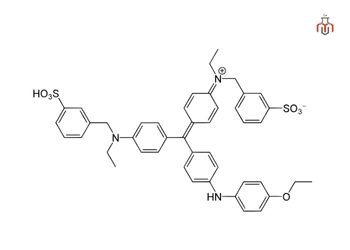
CAS No.: 6104-58-1
Synonyms: Acid Blue 90, Coomassie Brilliant Blue G, Coomassie Blue G, Xylene brilliant cyanine G, CBB G-250
| Properties | |
| Chemical formula | C47H48N3NaO7S2 |
| IUPAC name | N-[4-[[4-[(4-ethoxyphenyl)amino]phenyl][4-[ethyl[(3-sulfophenyl)methyl]amino]-2-methylphenyl]methylene] -3-methyl-2,5-cyclohexadien-1-ylidene]-N-ethyl-3-sulfobenzenemethanaminium sodium salt |
| Molecular weight | 854.0 g/mol |
| Solubility | Freely soluble in water, methanol, and ethanol |
| Chemical class | Triphenylmethane dye |
| Appearance | Blue crystals |
| Color | Dark blue to violet |
Brilliant Blue is generally considered to have low toxicity, but there may be some side effects with improper handling, such as –
| Pictograms : |
|
| Hazard Statements : | H411 Toxic to aquatic life with long-lasting effects |
| Precautionary statements : | P273 Avoid release to the environment. regional/national/international regulations |
Brilliant Blue G, also known as Coomassie Brilliant Blue G-250, is a synthetic triphenylmethane dye widely used in research and diagnostic applications for staining and quantifying proteins, particularly in protein quantification assays such as the Bradford protein assay. It is also used as a disclosing (visualizing) agent in ophthalmological surgery to stain the internal limiting membrane (ILM).
CAS No.: 6104-58-1
Synonyms: Acid Blue 90, Coomassie Brilliant Blue G, Coomassie Blue G, Xylene brilliant cyanine G, CBB G-250
| Properties | |
| Chemical formula | C47H48N3NaO7S2 |
| IUPAC name | N-[4-[[4-[(4-ethoxyphenyl)amino]phenyl][4-[ethyl[(3-sulfophenyl)methyl]amino]-2-methylphenyl]methylene] -3-methyl-2,5-cyclohexadien-1-ylidene]-N-ethyl-3-sulfobenzenemethanaminium sodium salt |
| Molecular weight | 854.0 g/mol |
| Solubility | Freely soluble in water, methanol, and ethanol |
| Chemical class | Triphenylmethane dye |
| Appearance | Blue crystals |
| Color | Dark blue to violet |
Brilliant Blue is generally considered to have low toxicity, but there may be some side effects with improper handling, such as –
| Pictograms : |
|
| Hazard Statements : | H411 Toxic to aquatic life with long-lasting effects |
| Precautionary statements : | P273 Avoid release to the environment. regional/national/international regulations |